
Healthcare organizations depend on medical equipment to provide safe, accurate, and timely patient care. From diagnostic machines and patient monitoring systems to surgical equipment and laboratory devices, every piece of equipment needs regular inspection, servicing, calibration, and repair. Managing these activities manually can become difficult as the number of devices increases. This is where Medical Equipment Management Software can make a significant difference.
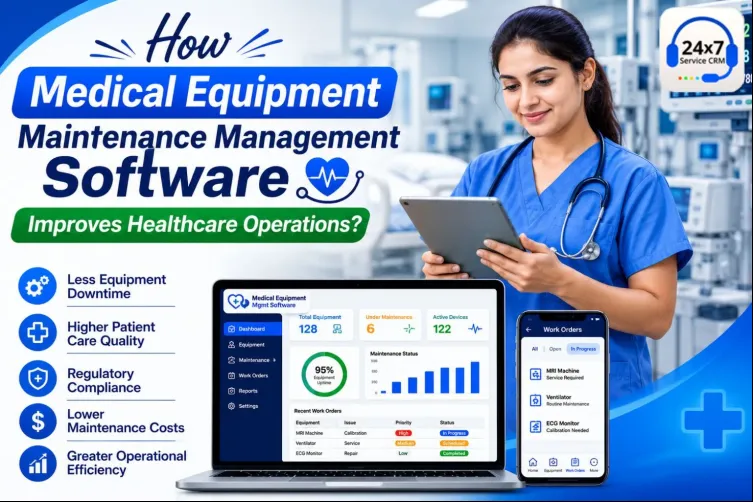
A modern Medical Equipment Maintenance Software solution helps hospitals, clinics, diagnostic centers, laboratories, and healthcare service providers organize equipment records, schedule preventive maintenance, track service requests, monitor technicians, and maintain complete service histories. When integrated with a Service CRM, healthcare organizations can improve operational efficiency while reducing equipment downtime and maintenance-related costs.
What Is Medical Equipment Management Software?
Medical Equipment Management Software is a digital platform designed to manage the complete lifecycle of healthcare equipment. It allows organizations to maintain centralized records for medical devices, including equipment details, purchase information, warranty status, service history, maintenance schedules, calibration records, and replacement requirements.
Instead of depending on spreadsheets, paper records, phone calls, or disconnected systems, healthcare teams can manage equipment-related activities from one centralized platform. This improves visibility and helps maintenance teams respond quickly when equipment requires attention.
Why Medical Equipment Maintenance Is Important
Medical equipment plays a critical role in diagnosis, treatment, monitoring, and patient care. Unexpected equipment failure can delay procedures, affect healthcare staff productivity, and potentially impact patient services.
Regular preventive maintenance helps identify problems before they become major failures. However, managing hundreds or thousands of devices manually can make it difficult to remember service dates, assign technicians, monitor spare parts, and document completed work.
Medical Equipment Maintenance Software automates many of these processes. It provides reminders for upcoming maintenance activities, helps teams prioritize service requests, and creates an organized record of every maintenance action.
Key Ways Medical Equipment Maintenance Software Improves Healthcare Operations
1. Centralized Equipment Records
One of the biggest advantages of Medical Equipment Management Software is centralized data management. Healthcare organizations can maintain detailed records for every medical device in one system.
Information such as equipment model, serial number, location, installation date, warranty, supplier details, maintenance frequency, and service history can be easily accessed by authorized users. This eliminates the need to search through multiple files or spreadsheets.
2. Better Preventive Maintenance Scheduling
Preventive maintenance is essential for keeping medical equipment reliable. Software can automatically schedule maintenance based on predefined service intervals.
Maintenance managers can receive alerts for upcoming inspections, calibration, servicing, and warranty expiration. This ensures that important maintenance activities are less likely to be missed.
By moving from reactive repairs to planned maintenance, healthcare facilities can reduce unexpected breakdowns and improve equipment availability.
3. Faster Service Request Management
When a medical device develops a problem, staff can quickly create a service request through the system. The request can include equipment information, reported problems, location, priority, and other relevant details.
The maintenance team can then assign the job to the appropriate technician. This creates a structured workflow from complaint registration to job completion.
A Service CRM can further improve this process by managing service requests, technician assignments, customer communication, and service updates from a single platform.
4. Efficient Technician Management
Healthcare equipment maintenance often requires skilled technicians with specific technical expertise. Medical Equipment Maintenance Software helps managers assign jobs according to technician availability, location, skills, and workload.
Technicians can access assigned jobs, equipment information, maintenance instructions, and previous service records. This helps them prepare before visiting the equipment and reduces unnecessary delays.
5. Reduced Equipment Downtime
Equipment downtime can disrupt healthcare operations. When maintenance teams have immediate access to service histories, previous repair information, and maintenance schedules, they can diagnose and resolve issues more efficiently.
Automated alerts and real-time job tracking also help managers identify delayed maintenance activities. Faster response times can improve equipment uptime and operational continuity.
6. Improved Inventory and Spare Parts Management
Medical equipment maintenance frequently requires spare parts, consumables, and replacement components. Poor inventory management can delay repairs when required parts are unavailable.
A comprehensive Medical Equipment Management Software solution can help track spare parts usage, stock levels, purchase requirements, and consumption history. This allows maintenance teams to maintain appropriate stock levels and avoid unnecessary inventory expenses.
7. Complete Maintenance History
Maintaining accurate service records is essential for healthcare organizations. Software can automatically record inspections, repairs, preventive maintenance, calibration, replaced components, technician comments, and completion dates.
This creates a complete digital maintenance history for each device. Managers can use this information to identify frequently failing equipment and make better repair, replacement, and budgeting decisions.
8. Improved Compliance and Documentation
Healthcare facilities often need proper documentation for equipment maintenance, inspections, and calibration. Maintaining these records manually can be time-consuming and prone to errors.
Digital maintenance records provide better traceability and make it easier to retrieve required information when conducting internal reviews, audits, or equipment assessments.
9. Data-Driven Decision Making
Medical Equipment Maintenance Software transforms maintenance information into useful operational data. Managers can analyze equipment performance, maintenance frequency, repair costs, technician productivity, downtime, and recurring problems.
These insights help healthcare organizations determine whether equipment should be repaired, upgraded, replaced, or monitored more closely.
How Service CRM Supports Medical Equipment Maintenance
A Service CRM extends equipment maintenance management beyond basic asset tracking. It connects customers, service teams, technicians, equipment records, service requests, schedules, invoices, and communication within one platform.
For medical equipment manufacturers, suppliers, dealers, and third-party service providers, Service CRM can be particularly useful. It can support AMC management, service contracts, field technician scheduling, customer support, spare parts management, and service reporting.
For example, when a hospital raises a service request, the system can record the complaint, assign a technician, track the service visit, update the equipment history, record parts used, and close the job after completion.
Benefits for Healthcare Organizations
Implementing Medical Equipment Management Software can provide several long-term benefits, including:
· Reduced unexpected equipment failures
· Better preventive maintenance planning
· Faster service response
· Improved technician productivity
· Centralized equipment information
· Better spare parts management
· Reduced maintenance costs
· Improved equipment utilization
· Accurate service documentation
· Better operational visibility
These benefits allow healthcare organizations to spend less time managing administrative maintenance tasks and more time focusing on efficient patient services.
Conclusion
Efficient medical equipment maintenance is an important part of modern healthcare operations. As healthcare facilities continue to use increasingly complex equipment, manual maintenance processes can create delays, data gaps, and unnecessary operational costs.
Medical Equipment Management Software provides a centralized and organized approach to managing healthcare equipment throughout its lifecycle. With preventive maintenance scheduling, service request management, technician tracking, inventory control, equipment history, and reporting capabilities, organizations can improve equipment reliability and operational efficiency.
When combined with a powerful Service CRM, healthcare service providers can create a connected maintenance ecosystem that improves communication between customers, technicians, service managers, and administrators.
For hospitals, clinics, diagnostic centers, laboratories, medical equipment manufacturers, and service companies, investing in reliable Medical Equipment Maintenance Software can be an important step toward more efficient, transparent, and technology-driven healthcare operations.
